
Zirconia · lithium disilicate · feldspathic ceramic
Strength where the case needs it.
Two zirconia grades, a lithium disilicate block and a feldspathic ceramic block, each with its properties, indications and firing programme on this page.
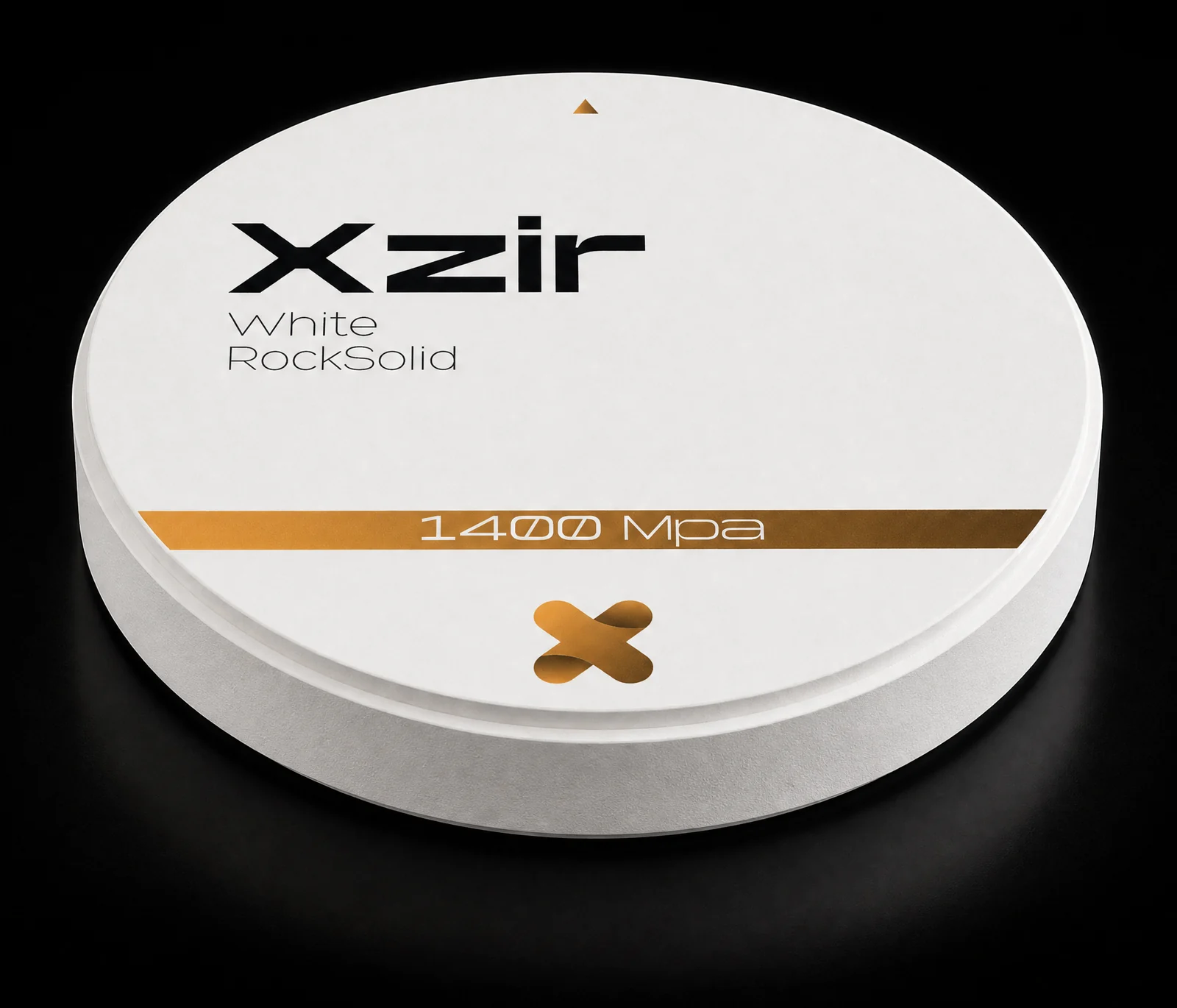

Zirconia disc · high translucent · white body
White RockSolid.
A white-body disc shaded in the lab with colouring liquid, so one stock item covers sixteen shades. Flexural strength is stated as a minimum: ≥1400 MPa.
- Crown
- Inlay
- Onlay
- Bridge
- Coping
- Full arch
Want to sell Xzir in your market? Become a dealer
MPa
Flexural strength
%
Light transmittance
°C
Recommended sintering
Properties
- Flexural strength
- ≥1400 MPa
- Light transmittance
- 40%
- CTE (25–500 °C)
- 10.5 /K
- Density before sintering
- 3.10–3.20 g/cm³
- Density after sintering
- 6.08–6.10 g/cm³
- Sintering range
- 1500–1550 °C
Composition
- ZrO₂ + HfO₂ + Y₂O₃
- ≥99%
- Y₂O₃
- 4.5–6.0%
- Al₂O₃
- <0.25%
- Other oxides
- <0.15%
Colouring liquid — 16 shades
- A1
- A2
- A3
- A3.5
- A4
- B1
- B2
- B3
- B4
- C1
- C2
- C3
- C4
- D2
- D3
- D4
Shade liquids in 50 ml bottles. D0 dilution and T0 incisal translucency liquids, 50 ml. Red, blue and yellow indicator liquids, 10 ml.
Zirconia disc · multilayer · pre-shaded
4D Pro. Strength and translucency in layers.
A pre-shaded multilayer disc. The cervical layers carry the strength; translucency rises towards the incisal edge.
- Crown
- Inlay
- Coping
- Bridge
- Anterior
- Veneer
- Implant full crown
- Implant abutment
Want to sell Xzir in your market? Become a dealer
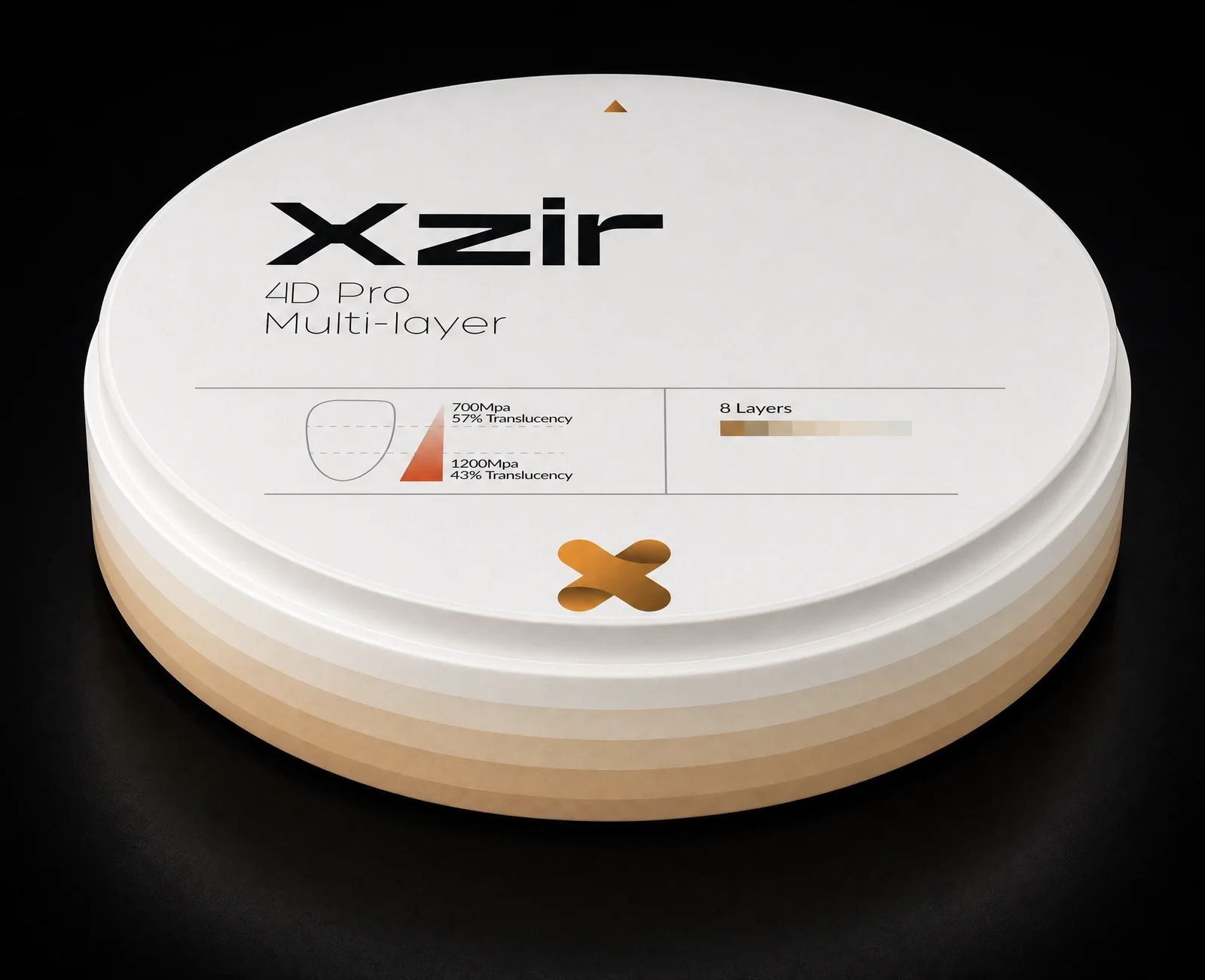
700MPa
Incisal
57% translucency
1200MPa
Cervical
43% translucency
Properties
- Flexural strength
- 700–1200 MPa
- Light transmittance
- 43–57%
- Layers
- 8
- CTE (25–500 °C)
- 10.0–11.0 /K
- Density before sintering
- 3.10–3.20 g/cm³
- Density after sintering
- 6.05–6.09 g/cm³
- Sintering range
- 1480–1530 °C
Composition
- ZrO₂ + HfO₂ + Y₂O₃
- ≥99%
- Y₂O₃
- 4.5–10%
- Al₂O₃
- <0.15%
- Other oxides
- <0.5%
Pre-shaded — 20 shades
- A1
- A2
- A3
- A3.5
- A4
- B1
- B2
- B3
- B4
- C1
- C2
- C3
- C4
- D2
- D3
- D4
- BL1
- BL2
- BL3
- BL4
Xzir formats
Discs for open and closed systems.
Formats available from our zirconia supplier. Confirm the formats you need when you order.
Ø98 mm disc
- System
- Open CAD/CAM
- Heights
- 10, 12, 14, 16, 18, 20, 22, 25, 30 mm
Ø95 mm disc
- System
- Zirkonzahn
- Heights
- 10, 12, 14, 16, 18, 20, 22, 25, 30 mm
89 × 71 mm block
- System
- Amann Girrbach
- Heights
- 12, 14, 16, 18, 20, 25 mm
Zirconia work — photographs from our zirconia supplier · click to enlarge

Lithium disilicate · CAD block · HT and LT
Pressed-ceramic aesthetics, without the press.
Lithium disilicate blocks on a metal mandrel, milled, adjusted and polished, then crystallised and glazed.
- Crown
- Inlay
- Onlay
- Veneer
18 × 15 × 13mm
Single-unit block
40 × 15 × 15mm
Multi-unit block
HT · LT
Translucency
Want to sell X max in your market? Become a dealer
Before crystallisation
- 01
Separate the restoration from the support pin with the correct trimming tool. An unsuitable tool can cause fractures and fissures, especially near the margin.
- 02
Polish before firing, at low speed, with light force and in one direction only.
- 03
Do not polish one area for too long. Localised heating can cause fissures or cracks.
- 04
Check the fit on the model or in the mouth, and confirm the occlusal and proximal contacts.
Glazing and firing
- 01
Use low-temperature glazing paste only, below 840 °C.
- 02
Brush the glaze evenly. Do not apply it too thick, especially on the occlusal surface, and avoid thin areas.
- 03
Place the restoration on pyrocotton or equivalent sintering support during crystallisation.
- 04
Before a second crystallisation, clean in an ultrasonic cleaner and dry with oil-free air.

Feldspathic ceramic · CAD block
X par. Feldspathic ceramic.
Feldspathic ceramic blocks on a mandrel, from the X range.
Want to sell X par in your market? Become a dealer
Firing programmes
Sintering and crystallisation.
Programmes from the material manufacturers. Confirm each one against your own furnace manufacturer's instructions.
Xzir White RockSolid — sintering
- 500 °C
- at 100 min
- 1100 °C
- at 200 min
- 1530 °C reached
- at 250 min
- Hold at 1530 °C
- 250–400 min
- Cool to 1100 °C
- at 500 min
- Cool to 700 °C
- at 600 min
- Cool to 300 °C
- at 700 min
- Then
- Natural cooling
Xzir 4D Pro — sintering
- Heat at 3 °C/min
- 0–26 min
- Heat at 6 °C/min to 1000 °C
- to 180 min
- Hold at 1000 °C
- 180–190 min
- Heat at 5 °C/min to 1500 °C
- to 290 min
- Hold at 1500 °C
- 290–410 min
- Cool at −15 °C/min
- 410–510 min
- Then
- Natural cooling
X max — two-stage crystallisation (recommended)
- Starting temperature
- 400 °C
- Drying time
- 6 min
- Heating rate
- 60 °C/min
- Holding temperature
- 820 °C
- Residence time
- 10 s
- Heating rate
- 30 °C/min
- Holding temperature
- 840 °C
- Residence time
- 7 min
- Furnace temperature
- 700 °C
- Vacuum start / end
- 550/820 °C · 820/840 °C
X max — one-stage crystallisation
- Starting temperature
- 400 °C
- Drying time
- 30 s
- Heating rate
- 40 °C/min
- Holding temperature
- 840 °C
- Residence time
- 7 min
- Furnace temperature
- 700 °C
- Vacuum start / end
- 550 °C · 840 °C
Next step
Order the X range online.
Clinics and laboratories buy directly in our online shop. Want to sell the range in your market? Apply to become a dealer.